Sims origins and History
DISCLAIMER: The historical research presented here is the result of personal study and independent inquiry. It is provided for informational purposes only. While I strive for accuracy based on the available sources, I am not a professional historian or genealogist, and this content is not guaranteed to be free from error, complete, or up-to-date. The findings represent my interpretations and not the official position of any historical society or institution. -Yuki Hellis, Lead for NC Fellow Cohort 7, 2026.
Introduction
The Town of Sims, located on the Western edge of Wilson County, North Carolina, is a small municipality that operates under a mayor-council form of government with a population of 434 (NC OSBM, 2024) that is growing every year.
Dolly Stallings, from the Archives of William Bexley Boykin. Taken in the 1920’s on Main Street with a railroad car in the background.
The town grew from a small railroad stop into a close‑knit community grounded in agriculture and natural resources. Originally known as “Simms Siding,” the community’s name traces to William Wiley “Billie” Simms and his W. W. Simms Lumber Company, which operated beside the Norfolk Southern Railroad in Old Fields Township at the beginning of the 20th century. Freight cars loaded with mill products, especially house siding, made “Simms Siding” a familiar stop in Western Wilson County.
The town has seen various changes in landscapes, people, and businesses throughout the decades. Despite a decline in population from the 1980s–2000s, the community has experienced rapid growth (120.3% change in population from 2000-2010) due to its proximity to major highways like U.S. 264 and I-95, facilitating easy access to larger cities such as Wilson, Raleigh, Greenville, and Goldsboro. This accessibility has attracted new residential developments, including Wilson County's first gated community, Crystal Lake Commons. Sims is currently home to approximately 19 businesses and amenities such as two community centers, a community park, and a book locker.
Today, Sims remains a friendly, neighborly town with a proud past and an eye on thoughtful growth. Sims embodies the essence of small-town living, characterized by a close-knit community where residents are familiar with one another, fostering a sense of belonging and connection. The town maintains a relaxed pace, emphasizing local traditions and a simpler way of life. Future plans feature the revival of the downtown business district on Main Street, a park expansion, and improving town connectivity through multimodal planning.
Shaded Blue In-Town Limits (Wilson County GIS, 2026)
Shaded Blue In-Town Limits; Grey Shaded Extraterritorial Jurisdiction (ETJ) Limits (Wilson County GIS, 2026)
Notably unique, Sims is the youngest town in Wilson County and is the first, aside from the city of Wilson, to install a historical marker. Through these initiatives, the Town of Sims demonstrates a strong commitment to preserving its rural characteristics while adapting to growth to improve the quality of life for residents.
Brief Timeline
Pre-European Colonization: The region that would become Wilson County was home to the Tuscarora and other Indigenous peoples.
Late 17th Century and Early 18th Century: Farming settlements.
1711-1713: Tuscarora War; the conflict ended with the battle at Fort Neoheroka in present-day Greene County.
1839: Wilmington and Raleigh Railroad extended into the region.
1855: Wilson County created from parts of Edgecombe, Nash, Wayne, and Johnston Counties
1868: Old Fields Township boundaries established.
1898–1899: William Wiley “Billie” Simms Jr. establishes and incorporates his lumber company. This helped spur settlement and growth around Simms Siding.
1907: Main line of the Norfolk and Southern Railroad completed.
1908–1909: U.S. Post Office established at “Simms,” marking a distinct community identity (first postmaster: Mark Peel); Simms Siding appears as a named railroad location.
1913: Town of Sims is chartered and incorporated by the North Carolina General Assembly as “Simms” (dropping “Siding”); first mayor (D. R. Weaver) and commissioners appointed (J. M. Burnett, Joseph S. Bailey and Nathan Peele).
1921: W. W. Simms retired from the lumber business and sold the company. The new owners were R. G. Briggs, President; W. T. Condon, Vice President; and L. P. McFarland, Secretary.
1923: Sims School (New) and Rock Ridge School (New) opened as part of school consolidation.
1923: Sims is re-incorporated as “Sims”. In the 1923 legislation, Eddie Nichols replaced Nathan Peele as town commissioner and J. L. Hinnant as mayor. However, in a 1962 newspaper article, the mayor in 1923 was reported as W. H. Jones who served as mayor until 1931. The article also listed the 1923 town commissioners as: J. W. Burnett, J. S. Bailey and A. T. Byrd; records from the period vary, and both accounts are part of the town’s historical record.
1929: Sims “Colored” School Building constructed with Rosenwald Funds.
1924: Nichols Drug Store and soda fountain were popular gathering places for the folks in Sims. Dr. Thomas Gavin Bradshaw from Rock Ridge had an office in the back of Aaron Nichols’ Drug Store on Main Street. Dr. Bradshaw had office hours every afternoon and treated area patients. Bobby Ruffin operated a video rental store in the same building in the 1990s.
1926: Main Street was completed, though not yet paved. Main Street was most likely gravel, what is now HWY 264 Alt. was a dirt road.
1930: Burnett’s Supply Company fire; Population 122.
1932: Town sold its electric light and power distribution system to Carolina Power and Light Company; W. W. Simms died the same year.
1940: Population 173.
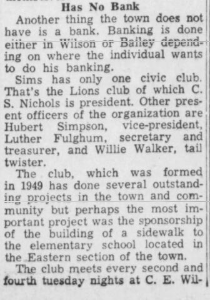
1949: The Lions Club was formed and the principal of Sims School, A. O. Folk, was elected as the club’s first president.
1950: Population 207.
1951: Most streets in Sims were paved.
1951: Sims Colored School closed and was sold.
1953: The North Carolina General Assembly increased the number of commissioners in Sims from three to five.
1960: Population 205.
1964: The Town constructed its first public water distribution system, replacing individual wells on residents’ properties.
1970: Sims Graded School and Rock Ridge School integrated; Population 205.
1971: First hired policeman reportedly employed by the Town.
1977: Old Highway 264 name change to Highway 264 Alternative/Business; Request to DOT to conduct investigation concerning the installation of flashing red lights at the highway-railway crossing on Main Street.
1978: Sims School closed.
1979: Sims Community Rural Fire Department (SVFD) organized as a nonprofit responder for Old Fields/Toisnot service areas.
1980: Population 192.
1986: Bullock-Dew House near Sims listed on the National Register of Historic Places.
1989: Planning board established and ETJ adopted.
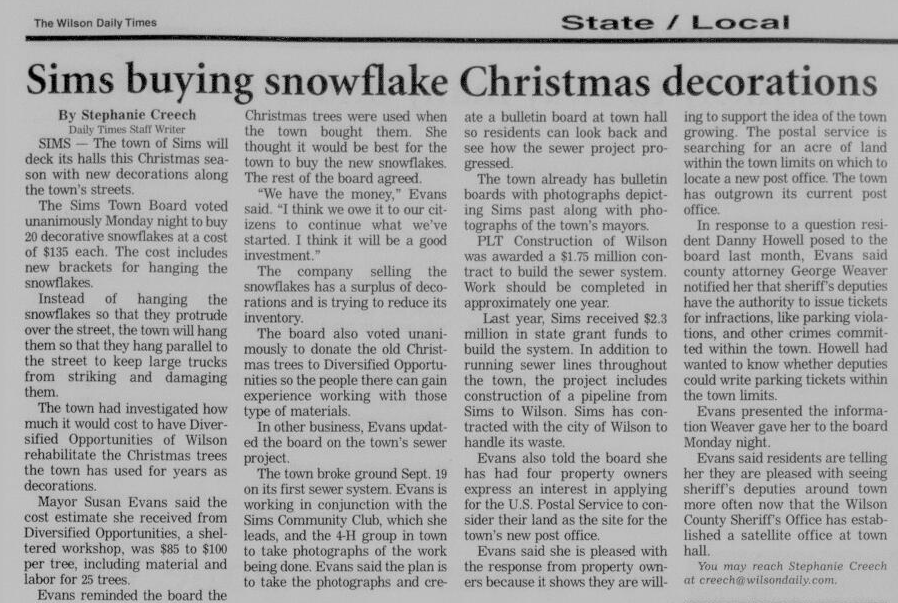
1990: First Christmas decorations installed on utility poles; Population 124.
2000: Population 128.
2002: First public sewer collection system completed and connected to the City of Wilson.
2004: Completion of upgraded public water distribution system to replace original 1964 lines
2010: Population 282.
2015-2016: Town Hall moves to current location.
2019: Sims Community Park completed; First Community Park Celebration.
2020: Population 275.
2022: Town adopts 10-year Land Use Plan.
2024: OSBM Certified population estimate reached 434.
2025: Town installed first historical marker.
2026: Town completes 2nd renovated Community Center on Main Street.
Pre-European Contact
Long before Wilson County was created, Indigenous people lived and cared for this region for millennia. North Carolina was home to many Native nations, including the Cherokee, Meherrin, Pamlico, Coree, Saponi, Tutelo, Waccamaw, Cheraw, and Catawba.
At the time of English colonization, the area that is now Wilson County lay within the homeland of the Tuscarora, an Iroquoian-speaking (Skarù·ręʔ) people who occupied much of North Carolina’s inner Coastal Plain. They established towns/confederacies along the rivers of Eastern North Carolina, including the Neuse, Tar, Roanoke, and Pamlico systems.
In the Wilson area, local memory of this history remains in the Tosneoc Village marker in Wilson, which identifies a Tuscarora settlement (Circa 800 AD - early 18th century), about five miles east of the city and notes that English explorer John Lawson visited it in 1709.
POST-EUROPEAN CONTACT
By the late 1600s and early 1700s, tensions between colonists (alongside their allied Native Tribes) and the Tuscarora had grown sharply. Major causes included the seizure of Native land, restrictions on hunting, exploitative trade, and the capture and sale of Native people into slavery. The founding of New Bern in 1710 added further pressure on Tuscarora communities and may have sparked the Tuscarora War of 1711–1713. In 1711, the Tuscarora attacked White settlements along the Neuse and Pamlico River, marking the beginning of a violent war.
Despite attempts at peace treaties, the final major battle at Fort Neoheroka (Nooherooka) in present-day Greene County (located about 40 minutes south of the Town of Sims) led to the defeat of the Tuscarora. Hundreds of Tuscarora men, women, and children were killed, and hundreds more were captured and sold into slavery. Many Tuscarora survivors migrated to New York and joined the Haudenosaunee/Iroquois Confederacy, while others remained in North Carolina, forced onto a small reservation area in Hyde County.
Despite the various instances of displacement and assimilation, Tuscarora descendants remained in North Carolina, and their history and culture are still part of this region today.
Visit for more information:
OLD FIELDS TOWNSHIP
In 1855, Wilson County was created from small portions of Edgecombe, Nash, Wayne, and Johnston counties. 13 years later, Old Fields Township boundary lines were established by the Wilson County Commissioners in the year 1868. It is surrounded by Taylors, Wilson, Crossroads, Spring Fields Townships, and Nash County.
Four communities have long been recognized in Old Fields including Sims, Bullocks, Lamms, and Rock Ridge. Sims is located in the northwestern section of Old Fields Township. Old Fields contains other noted small places that have faded with time. These remain only as memory to some of the senior citizens in Old Fields. Each of the below small landmarks had a post office between 1890 and 1904.
Cerafe, named for Cerafe Bissette is located in North West section of Old Fields
Conner, located at intersection of State Road 1131 and 1123 in West section of Old Fields
Filemore, located six miles West of Wilson on State Road 1154 and 1161
Toledo, located South of Sims near Stotts Crossroads
Neverson, named for Neverson Williams, located on Norfolk Southern Railroad, West of Sims
Railroad Roots: From Simms Siding to Sims
Carolina Coastal Railway's heritage units lead train No.114 south on the original Norfolk Southern Railway main line toward Charlotte. (John Leopard, August 21, 2024)
1908 Train Schedule
North Carolina Christian Advocate (Greensboro, North Carolina) · 3 Sep 1908, p 15
In 1876, Elizabeth City and Norfolk Railroad was incorporated and soon changed the name to Norfolk and Southern Railway in 1882. In 1907 Norfolk and Southern consolidated with three eastern North Carolina railroads to form one system named Norfolk and Southern and extended the railroad from Raleigh to Wilson, including through Sims. Today, the rail line that runs through Sims is operated by the Carolina Coastal Railway (CLNA)
The Town began as an outgrowth of a large lumber company owned and operated by Stantonsburg farmer William Wiley “Billie” Simms. In 1898-1899, he acquired 5 acres of land in Wilson County and formed the W. W. Simms Lumber Company (through a 1943 newspaper article says it was named “Briggs and Simms”), incorporated with $25,000 in capital stock.
W. W. Simms Advertisement. (Hill Directory Co.’s Wilson, N. C. City Directory 1922-23 (Richmond: Hill Directory Co., Inc., 1922) vol. 5, 36.)
The company operated a sawmill, planing mill, drying kilns, and a variety of other wood-working machines. The lumber site was located beside the Norfolk-Southern Railroad between Bailey and Wilson that was completed in 1907. Eastbound steam locomotives took water at Bailey; the next named locations were Neverson and Simms Siding. According to a Norfolk & Southern Railway train schedule published in the Sunday edition of the News & Observer on June 21, 1908, Simm’s Siding became a stop and a recognized railroad location for loading the company’s wood products.
In 1908, the passenger fare from Simms Siding to Raleigh was $1.25. Norfolk Southern maintained a telegraph office here, though without a depot.
Post Office
Location of the original post office in 1930s on Main St. (Year Built: 1918). 2025, Yuki Hellis
Before the train stop, the U.S. mail stop for the area was at the home of Mark Peel, appointed postmaster on June 19, 1908.
Successive postmasters/postmistresses included Veanie Peel (who later married Dr. W. T. Sanders) and Christopher Columbus Peel, who served when “Simms” was incorporated in 1913. Jennie R. Flowers became postmistress in 1919 and served through the 1923 change to “Sims”
As the town grew, the post office moved from private homes into a corner of Eddie Nichols’ grocery on Main Street (later a furniture store operated by Osborne Keith Howell). Sometime in the 1950s, the post office moved to where it currently stands.
Post office 1955 (Wilson Daily Times Newspaper Archives May 6, 1955 Page 49)
Sims United States Post Office, 2025, Yuki Hellis
Charter and Incorporation
In 1913, the North Carolina General Assembly chartered and incorporated the town as “Simms” (dropping “Siding”) with D. R. Weaver as the first mayor, and J. M. Burnett, Joseph S. Bailey, and Nathan Peele serving as the first commissioners.
In 1923, the General Assembly revised and consolidated the charter and officially changed the town’s spelling from “Simms” to “Sims.” This reincorporation appointed J. M. Burnett, J. S. Bailey, and Eddie Nichols as commissioners and directed them to elect a mayor, appoint constables, adopt rules and ordinances, and hold office until their successors were elected. Some historical sources differ on who served as mayor and commissioners in 1923 including J. L. Hinnant or W. Henry Jones as mayor, and J. W. Burnett, J. S. Bailey and A. T. Byrd as commissioners.
1909 Simms Plat
(Wilson County Register of Deeds, Book 78, Page 83.)
An Act to Incorporate the Town of Simms in Wilson County, State of North Carolina. (PrL1913-293)
An Act to Incorporate the Town of Sims, North Carolina. (PrL1923-58) *Spelling of Town name changed by this act.
Scenery of Sims
Wilson Daily Times Newspaper from May 6, 1955 Page 49
Wilson County’s topography tends to run from rolling terrain of the piedmont in the Western end of the county, including Old Fields Township, to gradually transitioning to flatter lands as it begins to become part of the coastal plain geographic region.
This influenced Europeans, many of whom were wealthy planters and farmers, to begin their farming trades making products from the forests of pine trees, and with the enslaved people they bought, began mass agricultural production in the area (tobacco, cotton, timber, etc.). The area that is now Sims was most likely farmland until the railroad was built and the main community hub was built around Simms Siding.
According to William A. Stott (1987), what is now US HWY 264 Alt. was completed in 1926, though it was not paved and was likely gravel/dirt. Most streets in Sims were paved around 1951.
Older records indicate that the corridor (now HWY 264 Alt.) was originally part of NC Highway 91. Throughout the years, it has changed from US 264, US 264 Business, to US 264 Alternate. In 1977 there was a request to DOT to conduct investigation concerning the installation of flashing red lights at the highway-railway crossing on Main Street.
THEN VS NOW
Old Fields Township Pictures and Articles Presented to the Town of Sims by William A. Stott (1987): Picture most likely taken in the 50s
Corner of Wall St and Main St. May 2026, Yuki Hellis
Wilson Daily Times, August 12, 1962
Corner of Main St. and HWY 264 Alt. May 2026, Yuki Hellis
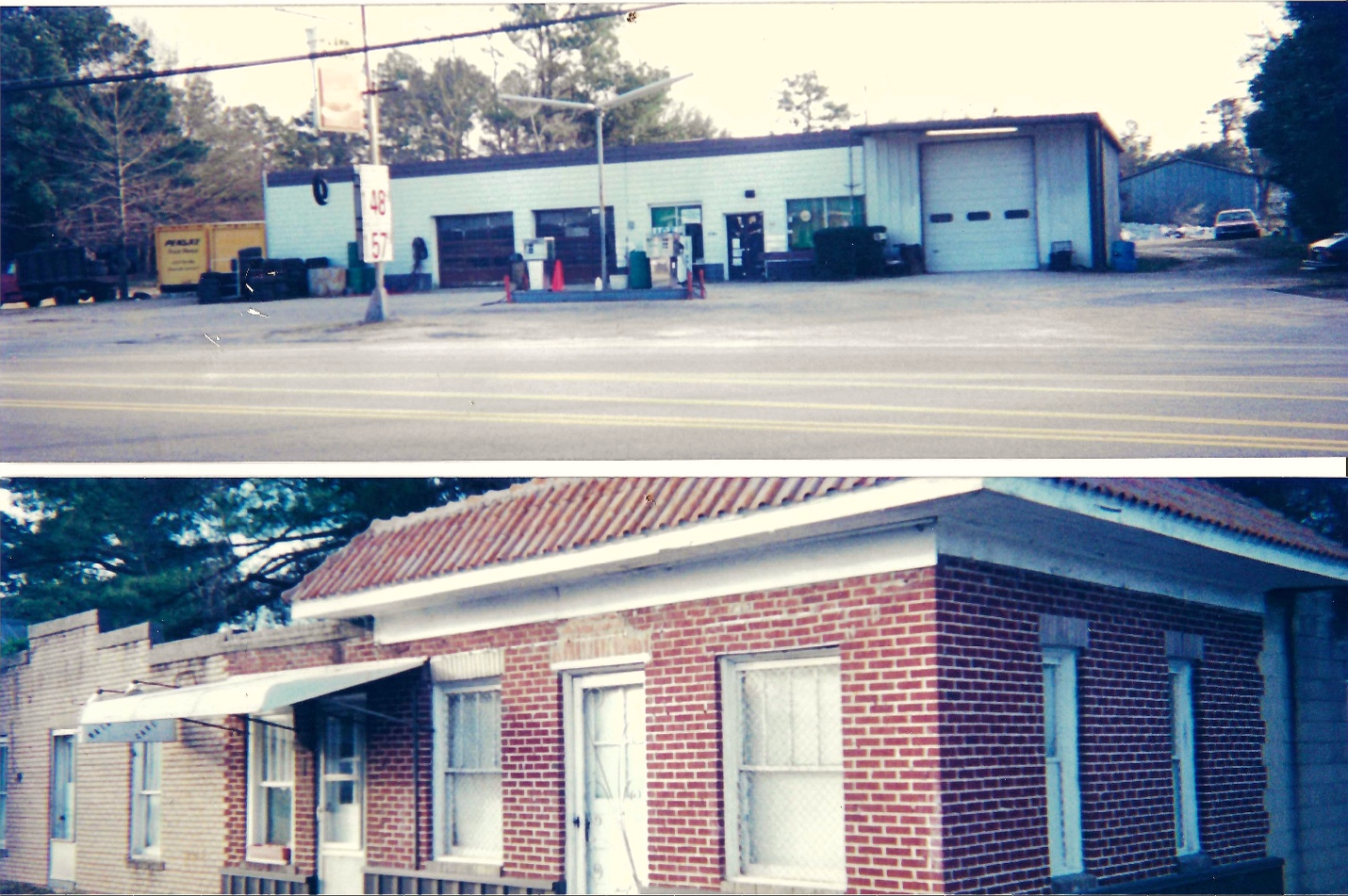
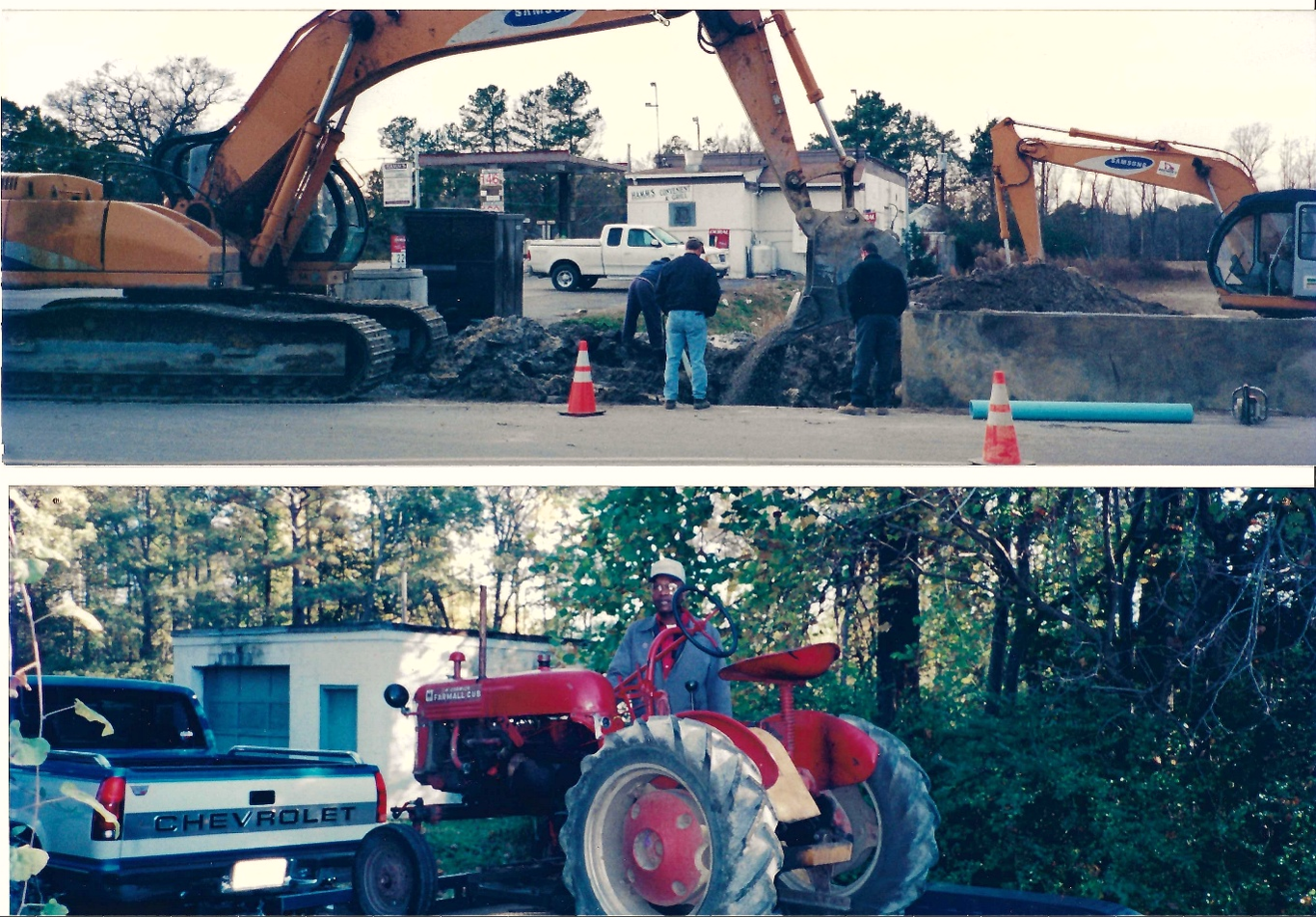
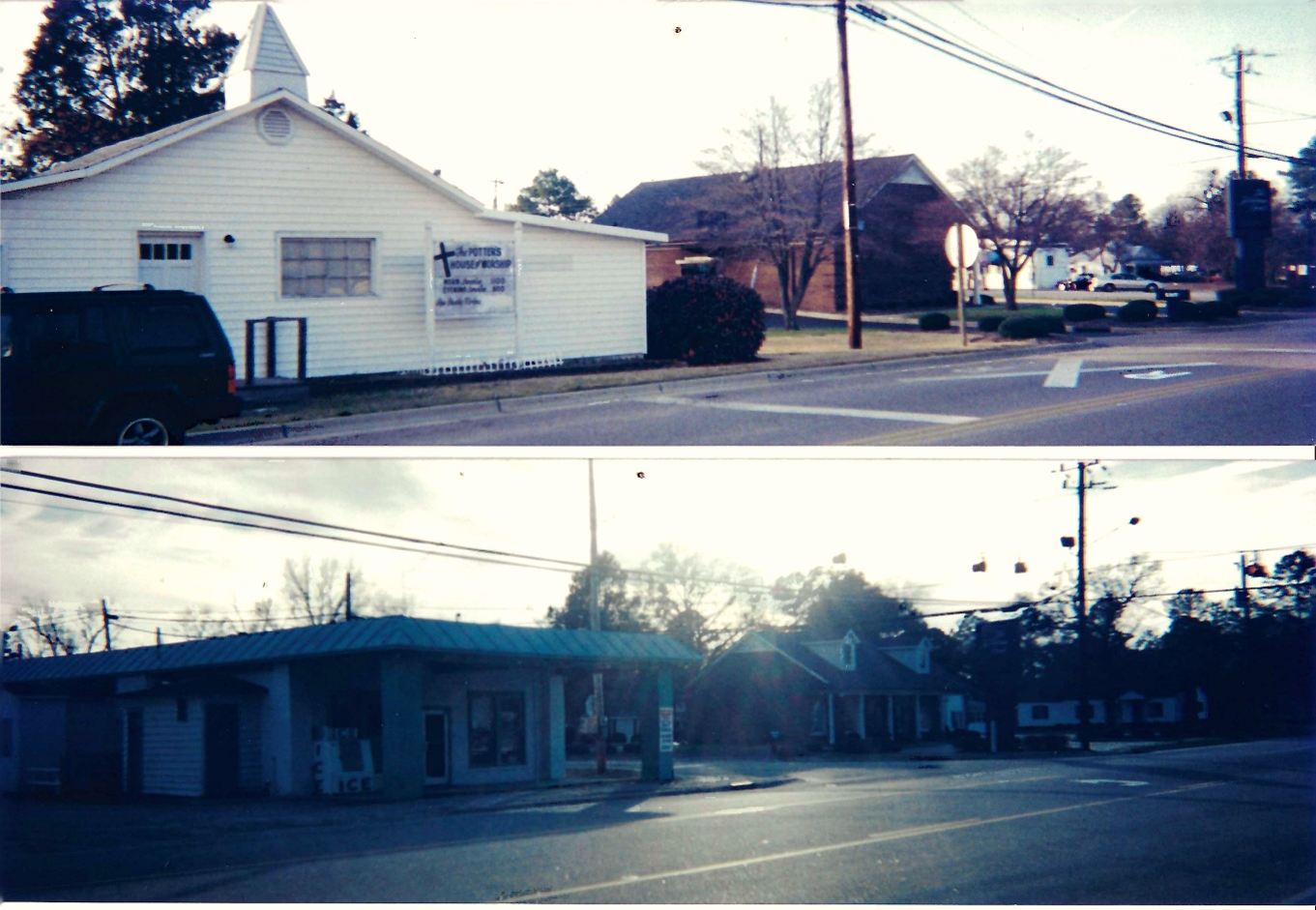
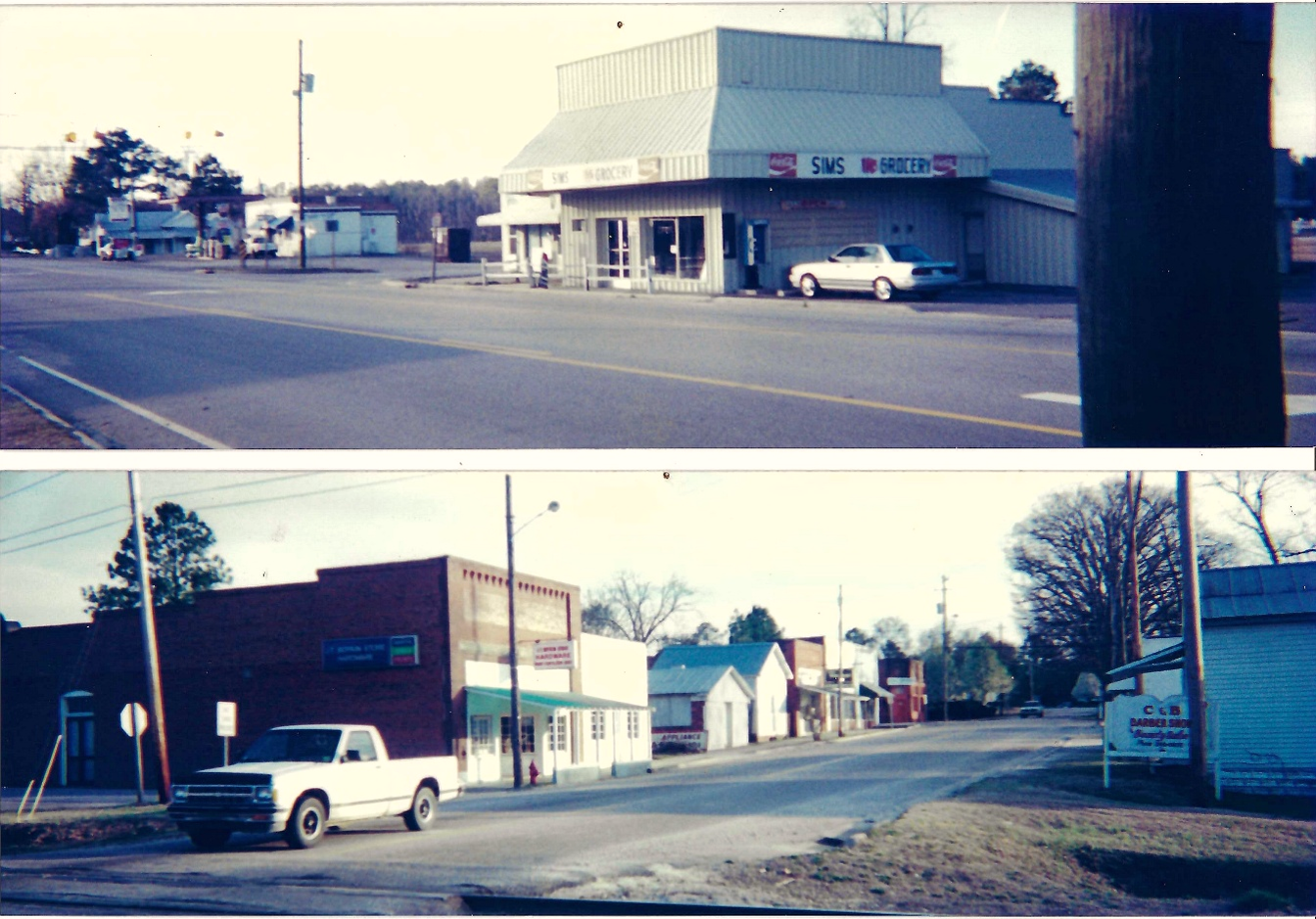
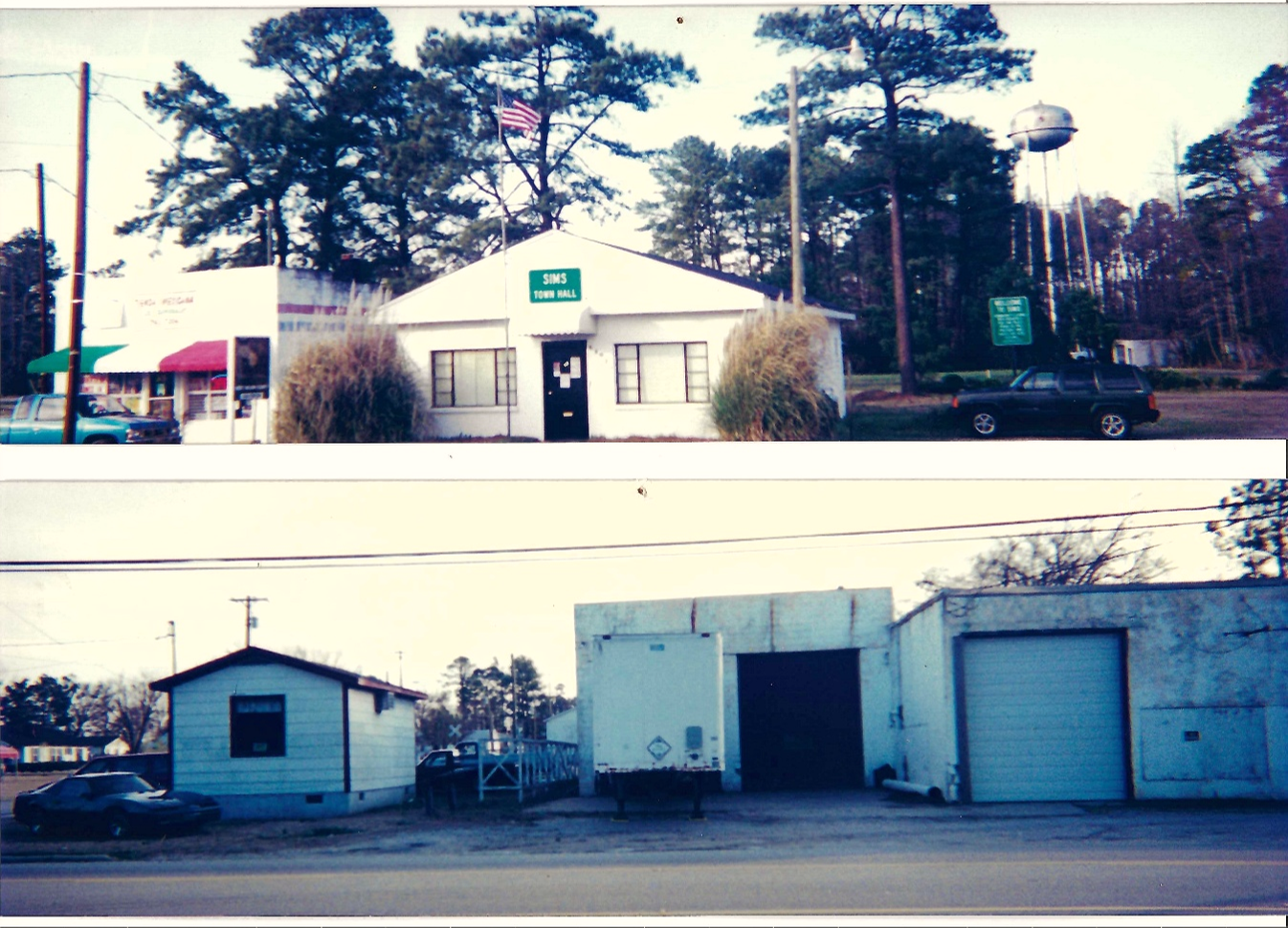
Pictures from 2001 in Sims Town Hall Records:
SIMS TOWN HALL & GOVERNANCE CHANGES
In March 1953, the General Assembly increased the number of Town Commissioners from three to five.
Town Hall was originally located where the HWY 264 Community Center is currently located (year built 1960) and housed the Town Clerk, Police Department, and Meeting Hall. The Town served as the voting place for residents in Old Fields Township in 1987.
Sims Town Hall from old Town brochure (unknown date)
Sims Town Hall: Unknown date (most likely 2000)
HWY 264 Community Center: 2025
TOWN VEHICLES
The Town owned vehicles including a patrol car for the police department, dump trucks (1951 Chevrolet dump truck and 1960 Ford dump truck), a tractor (1970 Farmall Cub), trash barrels, and a car for the mayor throughout the years.
Wilson Daily Times Newspaper Archives November 25, 1974 Page 2
UTILITIES, SERVICES, GOVERNANCE
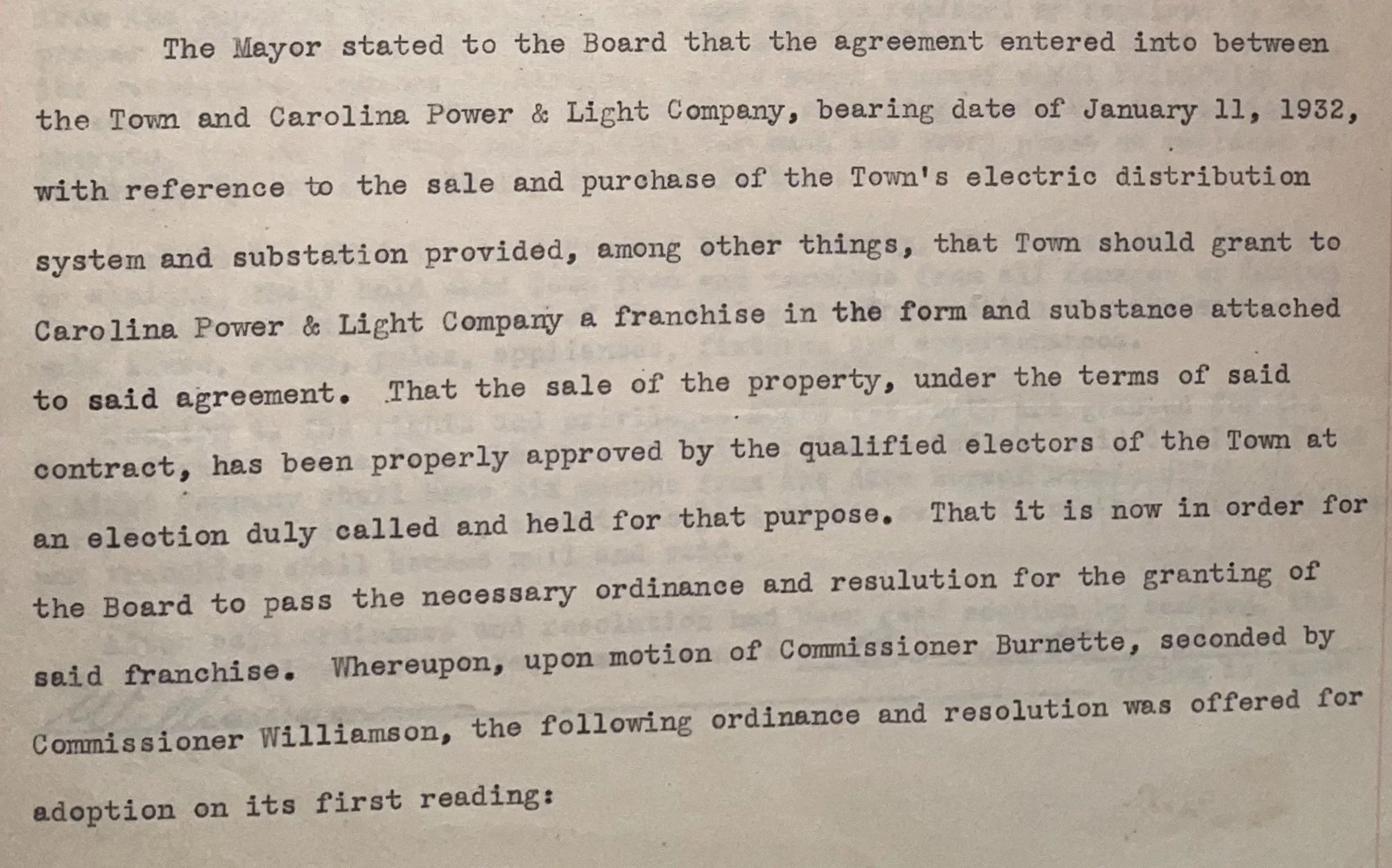
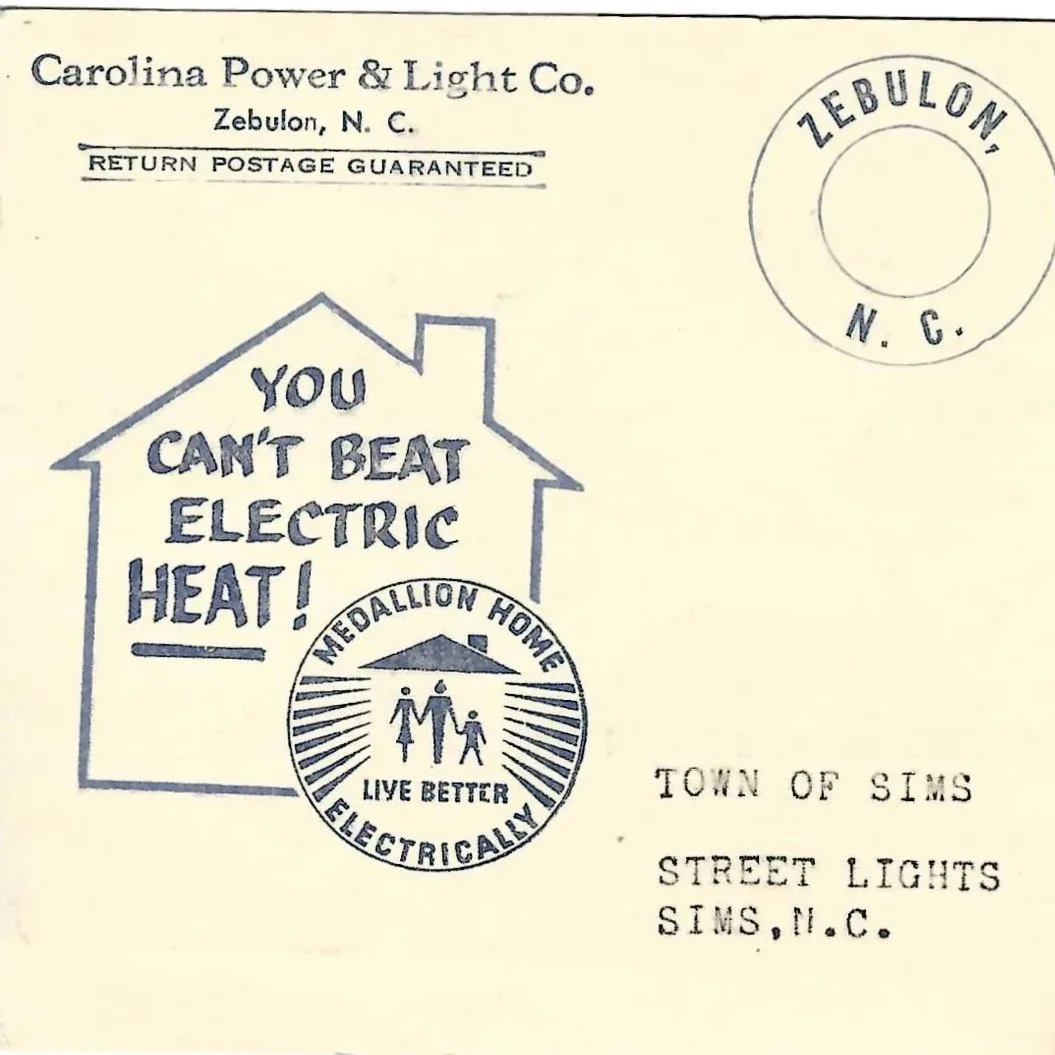
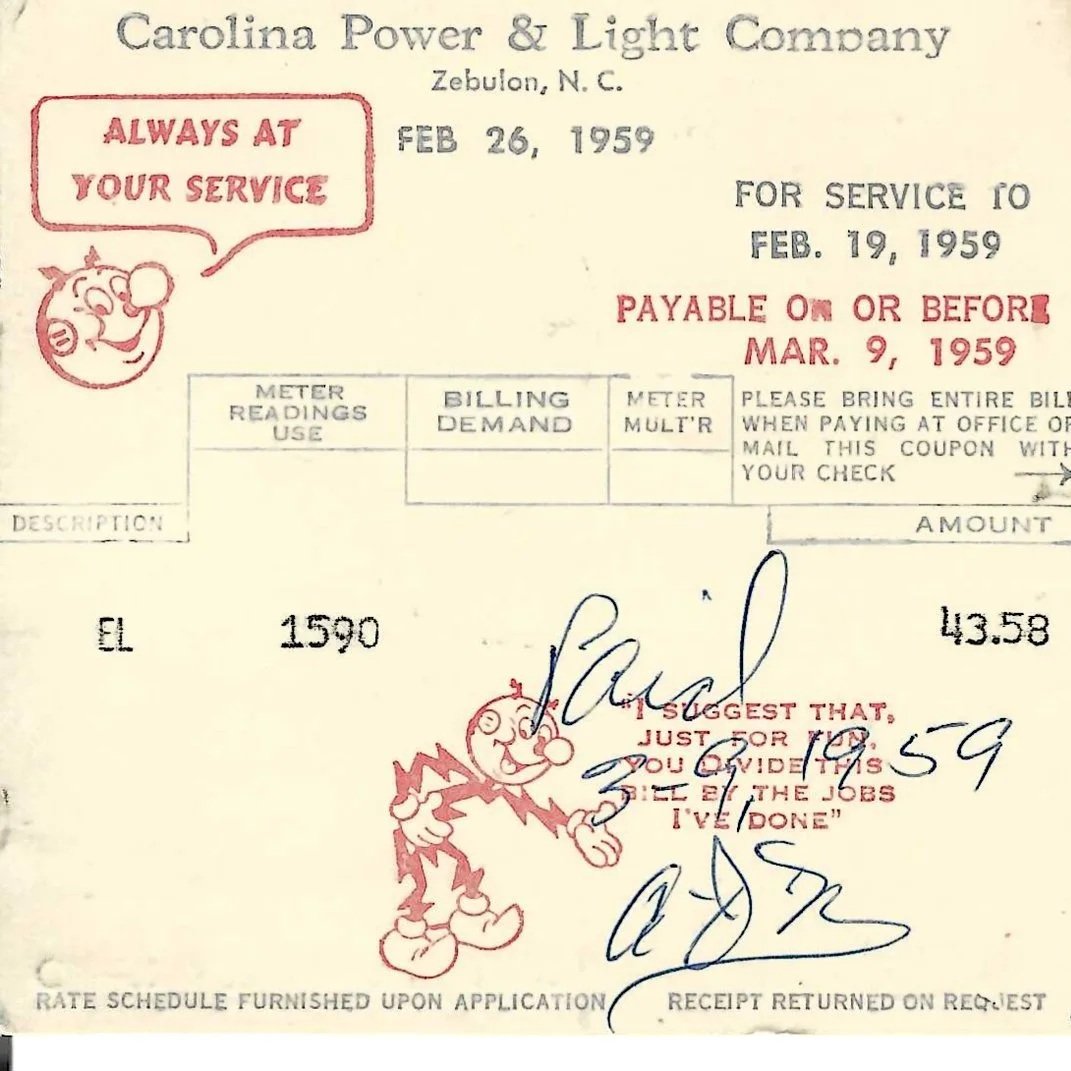
ELECTRIC: William A. Stott (1987) stated that the Town purchased streetlights in 1924 from Carolina Power and Light Company. A Wilson Daily Times article from August 17, 1962 states that Sims was the first municipality lighted in 1924. The Town ended up selling their electric light and power distribution system to the same company in 1932, which served the town for many years. In 1955, Sims was the only town that was not served by Wilson Electric Department.
WATER: In 1964-1965, the Town constructed its first public water distribution system, replacing individual wells on residents’ properties with a grant and loan from the federal government. 1978 was the first year water rates were increased.
Wilson Daily Times, March 27, 1965
1978 RIBBON CUTTING FOR US 264 OPENING:
1978 Letter to Mayor Richard Fulghum for US 264 Ribbon Cutting
Mayor Fulghum with Governor James B. Hunt Jr: Participation in 1978 Ribbon Cutting for US 264 Opening
TRASH: In the 70s, the town collected trash, but later switched services in the 80s.
CABLE: in 1988, the town awaited installation of cable television services
ESTABLISHMENT OF PLANNING BOARD AND EXTRATERRITORIAL JURISDICTION: Adopted October 2, 1989
Wilson Daily Times Newspaper Archives May 31, 1990 Page 3
Wilson Daily Times Newspaper Archives August 25, 1989 Page 25
Wilson Daily Times Newspaper Archives August 25, 1989 Page 25
OLD TOWN OF SIMS BROCHURE
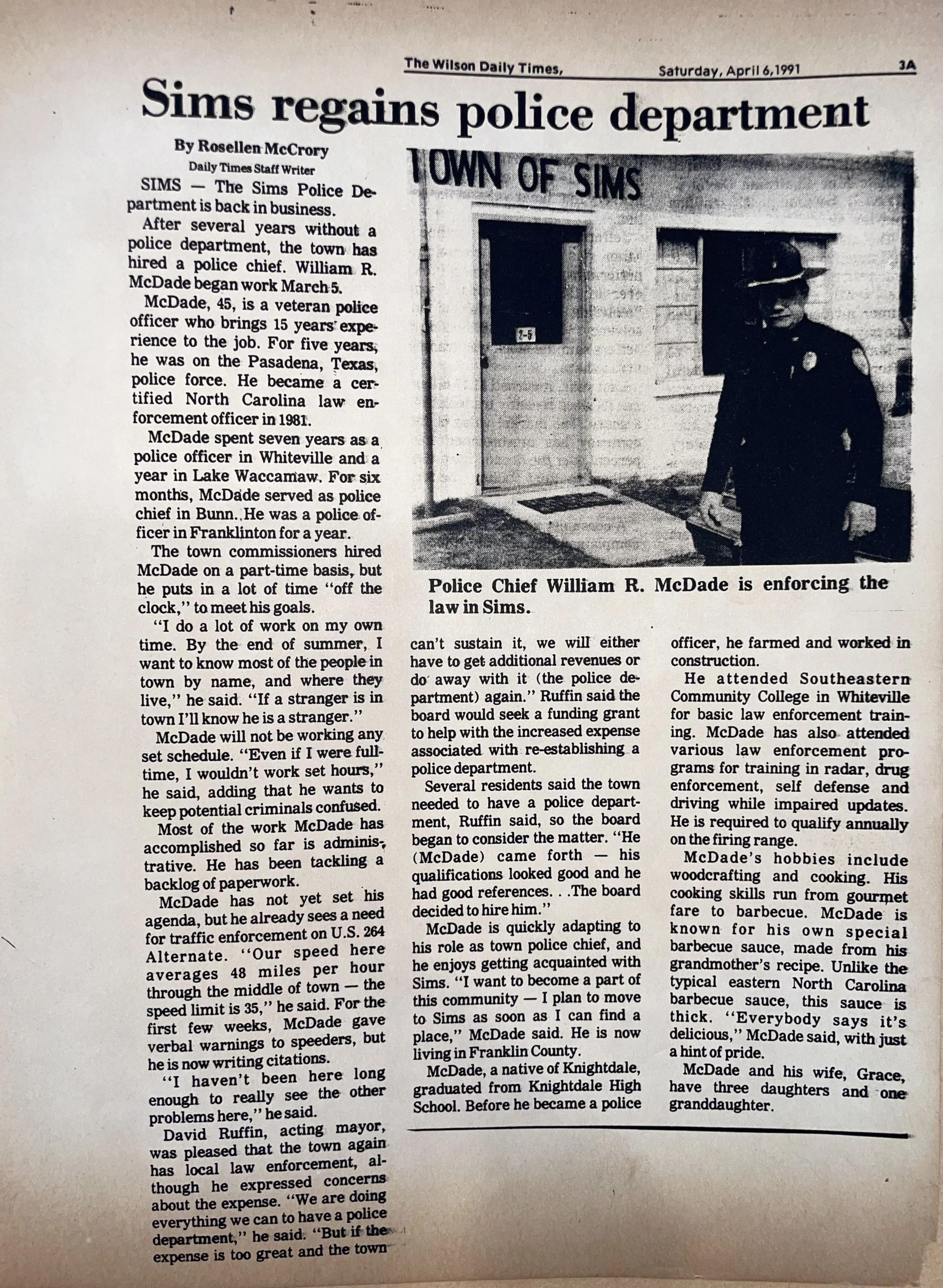
SIMS POLICE DEPARTMENT
1924 Minutes: “Williford be paid $43.33 for serving as Chief Police during Dec. 1923”
Wilson Daily Times Newspaper Archives February 27, 1981 Page 30
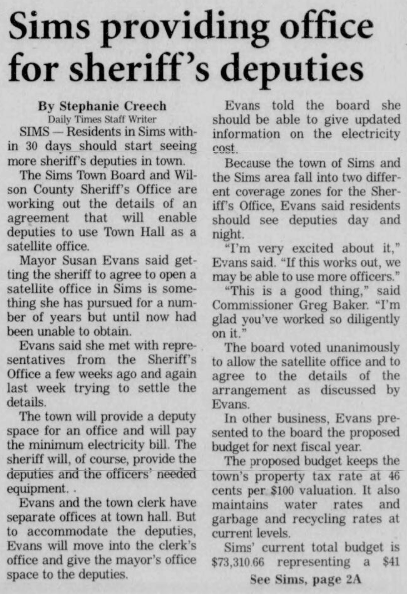
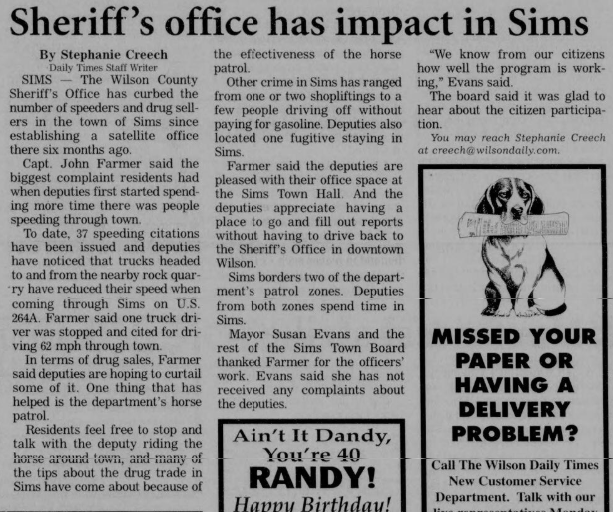
August 2000 opening of Sheriff’s Department in Town Hall
Wilson Daily Times Newspaper Archives May 6, 1955 Page 49
The Town had police as early as 1923, the year it was reincorporated. In 1955, Sims had a night watchman, but no police department.
There is a gap in the historic record until the 70s, when Sims received their “first” policeman in November 1971. The office was located in the left room of what is now HWY 264 Community Center. After a few years, the Town lost the department, possibly due to the dismantling of the Law Enforcement Assistance Administration (LEAA).
Sims reestablished a police department in 1991. Accounts from residents suggest that the police officers were paid from a grant in the 90s, when police chief William R. Mcdade was hired.
Since 2000, the old Town Hall/current Community Center hosts a satellite office for the West Wilson Substation, which is still used today.
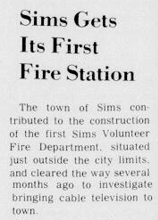
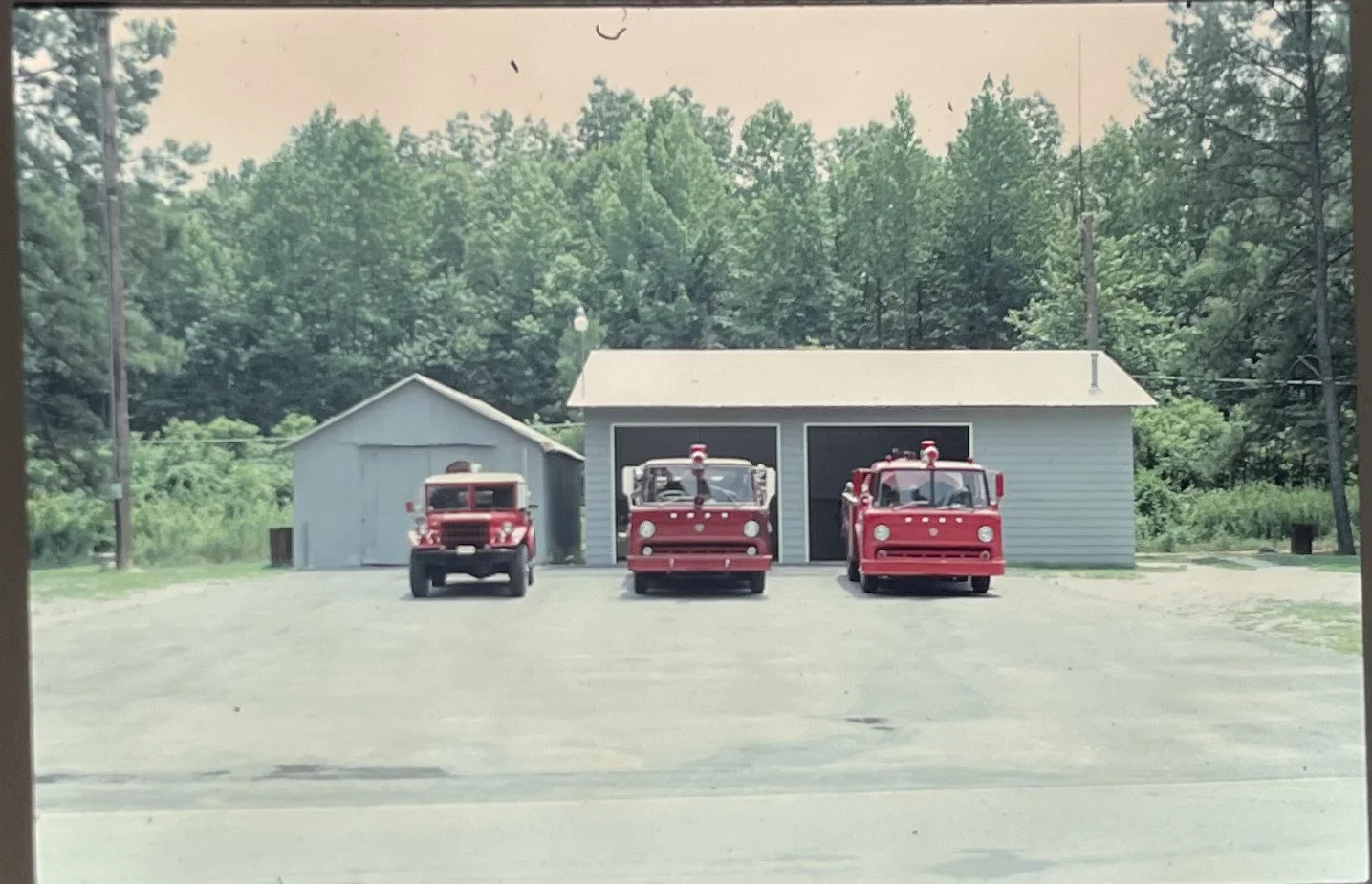
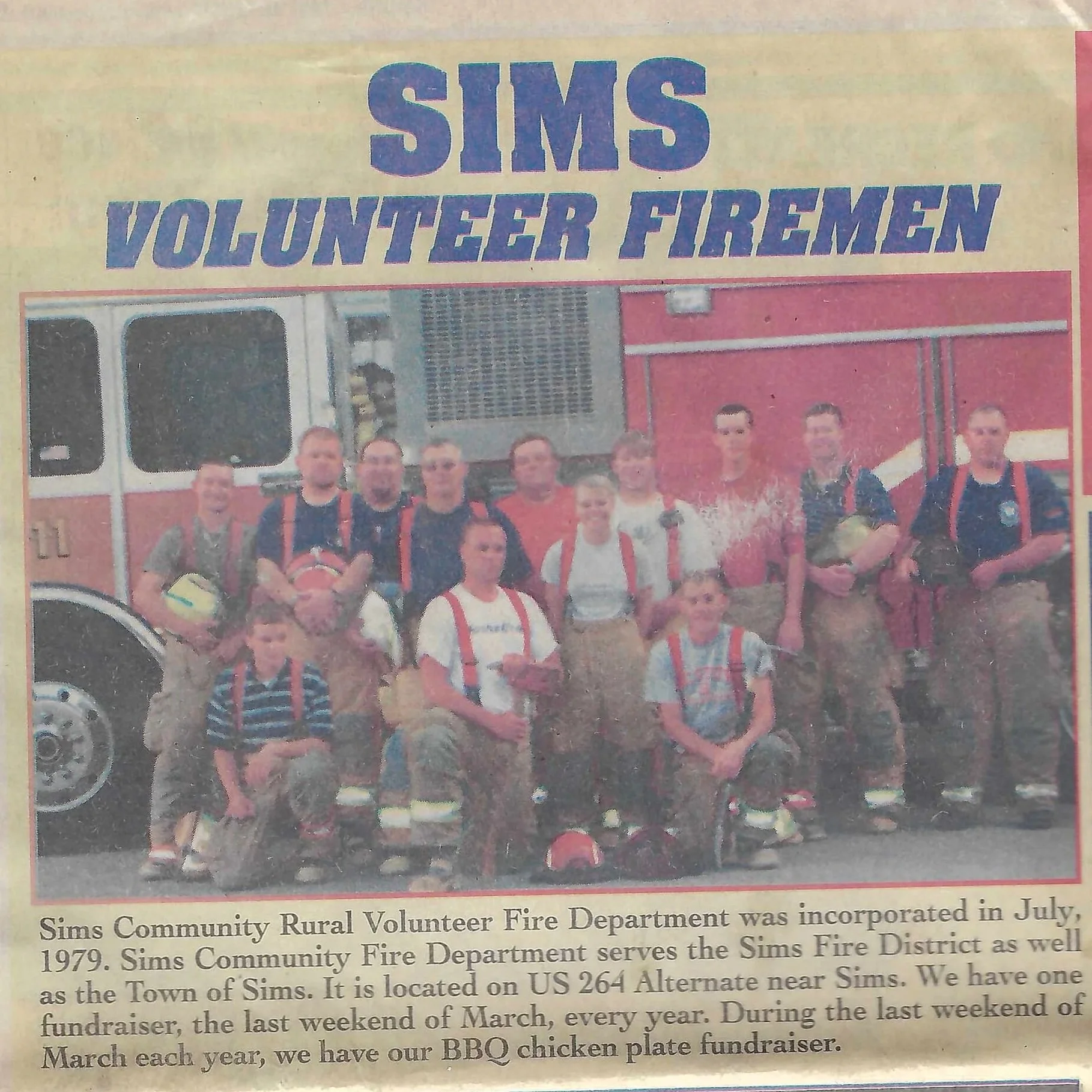
Sims Volunteer Fire Department
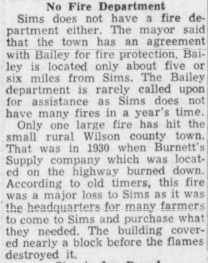
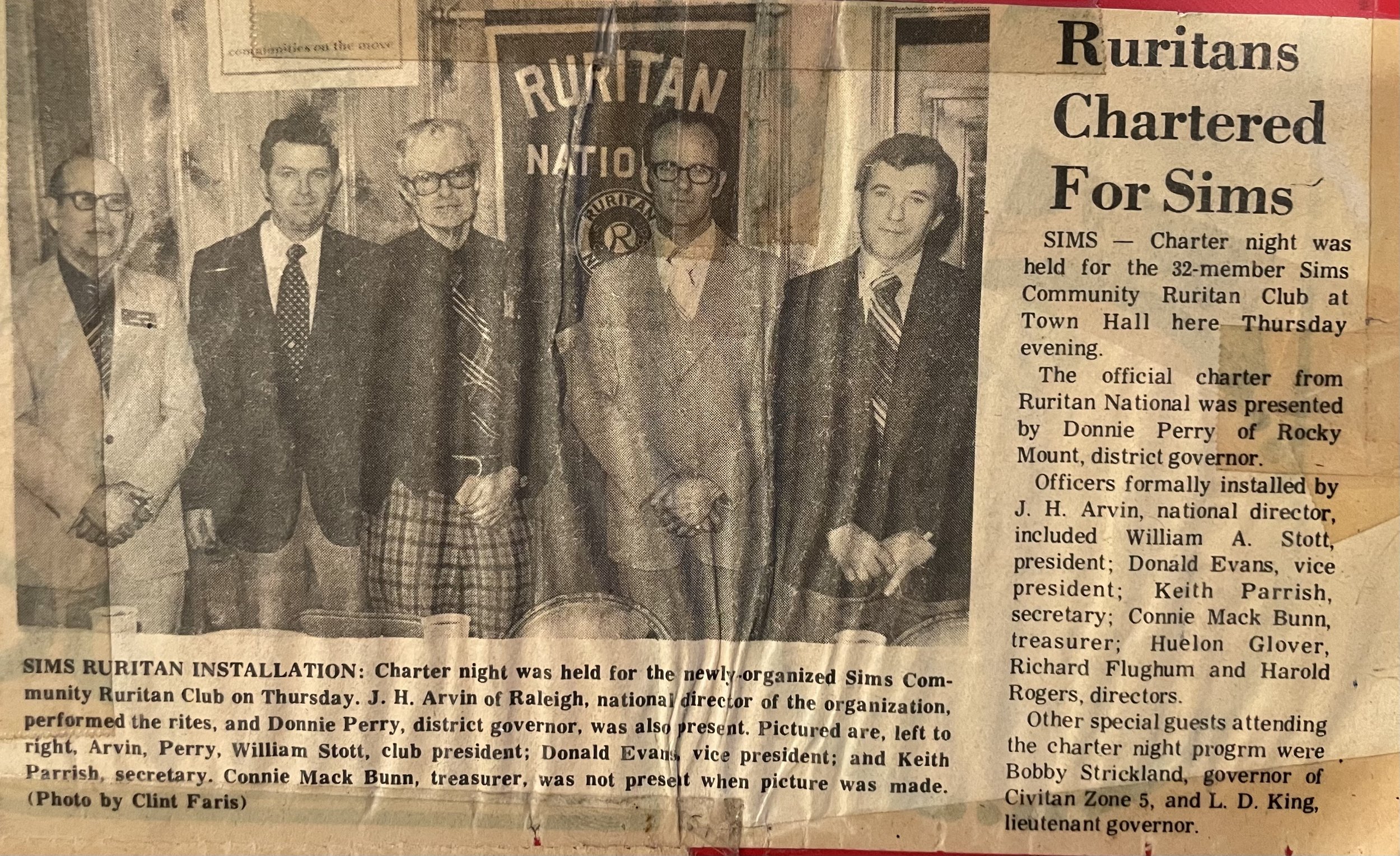
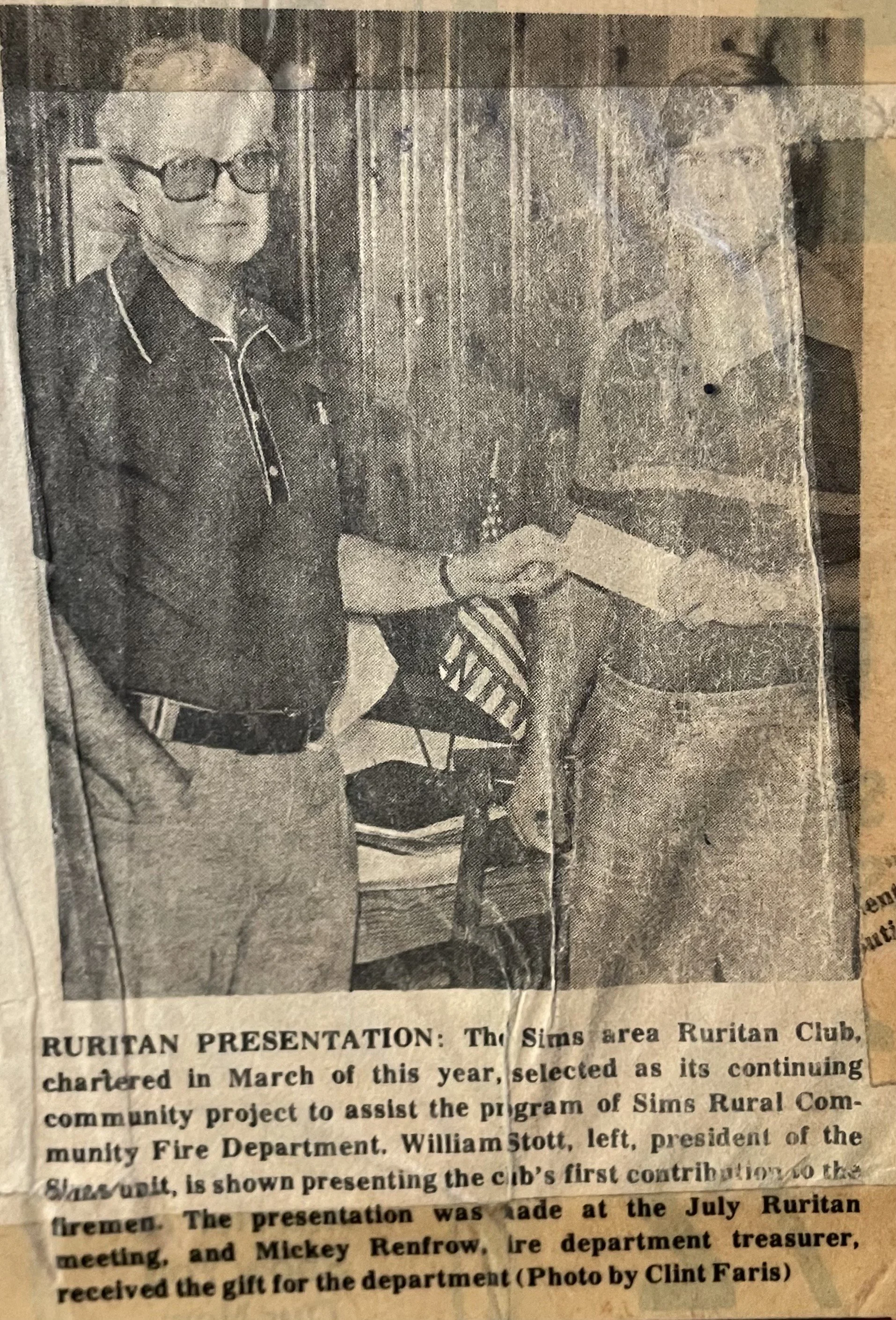
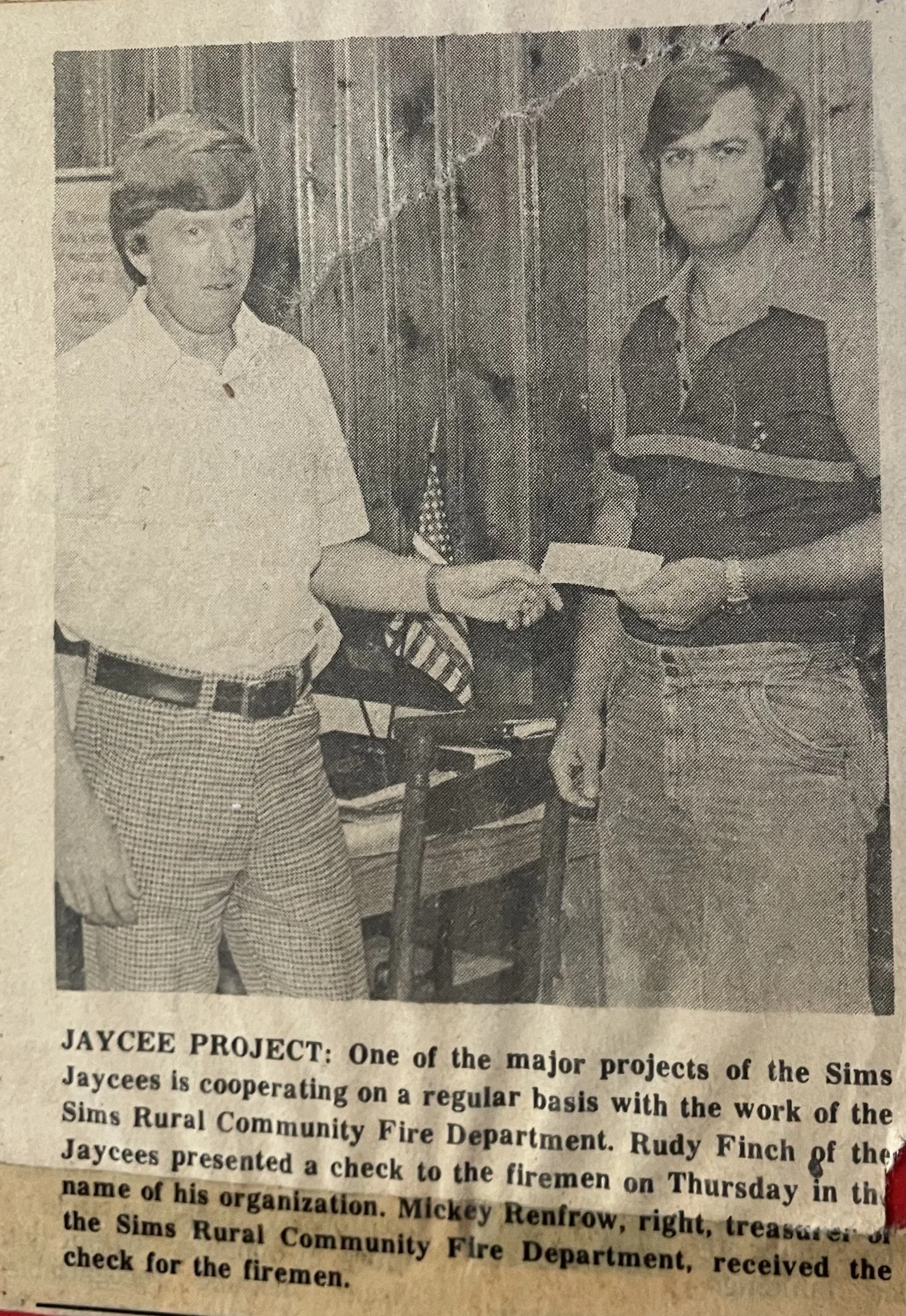
Sims Community Ruritan Club (later name change to Sims Rural Community Club) established the Sims Rural Community Fire Department in 1979 as the club’s first project. They serve the Town of Sims as well as the Sims Fire District.
LUCAMA-KENLY BANK/HERITAGE BANK/SOUTHERN BANK AND TRUST COMPANY
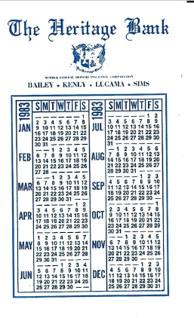
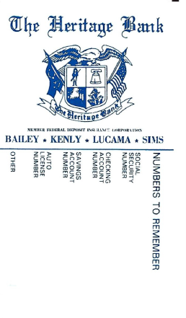
The Lucama-Kenly Bank branch opened in 1972, which later became Heritage Bank (and eventually Southern Bank and Trust Company). Before then, most Sims residents travelled 20 miles round trip to Wilson to conduct banking business.
Heritage Bank Card from 1983 and Paper Mat:

Wilson Daily Times Newspaper Archives May 25, 1972 Page 2
The Heritage Bank, Helen Boykin
Sims Town Hall 2025
Heritage Bank closed April 2013 and Southern Bank and Trust Company took over. Southern Bank and Trust Company sold the parcel of land to the Town of Sims on April 6, 2015. The move occurred between late 2015 and early 2016, and the old Town Hall became a Community Center.
Education
Visit this PDF for a deeper dive: Old Fields Township Education
Education in Sims developed within the larger framework of Old Fields Township and Wilson County. In the late nineteenth and early twentieth centuries, local schools reflected the broader pattern of rural North Carolina: small community schools, gradual consolidation, and a deeply unequal segregated system for White and Black students.
Note: A “school” could refer to any place where a county-paid teacher was assigned, including churches or other borrowed spaces.
Before Consolidation
In the late 19th century and early 20th century, majority of White public schools had buildings, but only a handful of Black public schools had permanent structures (until the Rosenwald fund of the early 20th century).
White Schools Before Consolidation
Sims Methodist Church
Rock Ridge, 1925
The Public Schools of Wilson County, North Carolina: Ten Years 1913-1914 to 1923-1924 by Charles L. Coon refers to Sims as a one-room school of the Neverson type, while the 1917 white-school map appears to show “Simms” as a two-room school. There were no photos of Simms as a school, but according to William A. Stott (1987), the Sims (wooden) School later became Sims Methodist Church.
Rock Ridge was a high school in the township completed in 1883. In 1914, a new two-story frame building served the community until 1923 when a new modern brick school was completed.
Black Schools Before Consolidation
Prior to the construction of the Rosenwald schools, there were no dedicated Black school buildings in Old Fields Township.
Sims “Colored” School was listed in the 1924 record as having “no house,” suggesting that before a permanent building existed, classes likely met in a borrowed space, most likely a church.
Sims Teacher’s Home from Wilson County Public Library
Consolidation and Rosenwald Fund
As state investment in education increased, Wilson County superintendent Charles L. Coon promoted a consolidated school system. In Old Fields Township, this led to construction of four new White schools: Rock Ridge as the standard high school, with Sims, Lamms, and Bullocks as feeder schools.
In the 1910s, Julius Rosenwald (a Chicago philanthropist and president of Sears, Roebuck and Co.) and Dr. Booker T. Washington (African American Educator, Author, or Orator) established a fund that provided architectural plans and matching grants after seeing the disheartening state of education among rural southern African Americans. Mr. Rosenwald was inspired by Dr. Washington’s book “Up from Slavery”, and they later met and shared their vision about the transformative power of education and self-determination for Black students.
White Schools after Consolidation
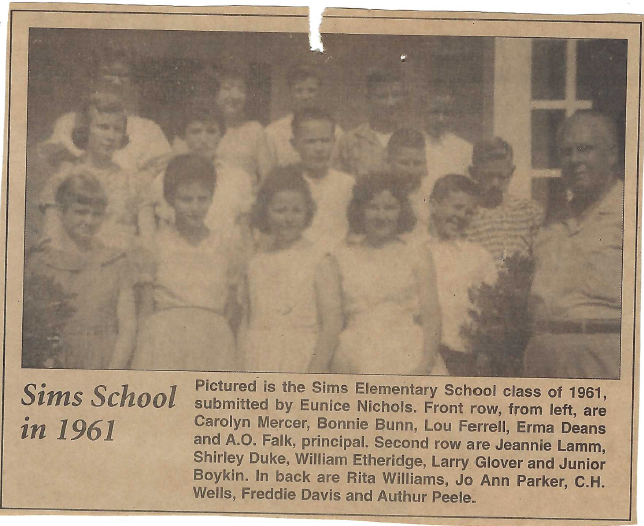
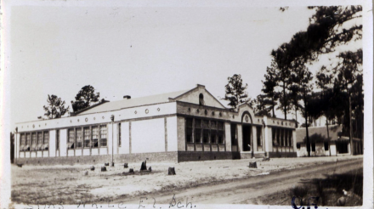
Simms/Sims (New) (1923-1978): Graded School
Completed in 1923 on a five-acre site, with six rooms serving grades 1 through 6. Enrollment in 1923–1924 was 232 students. It remained in operation until 1978, when students were reassigned to Rock Ridge. Integration of Black students began around 1970, and Sims School continued to serve the community until it closed in 1978, after which its students were reassigned to Rock Ridge. The building itself appears to have been demolished sometime between 1978 and 1981.
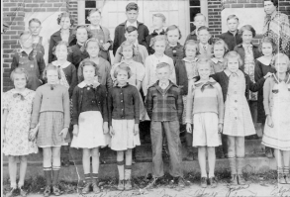
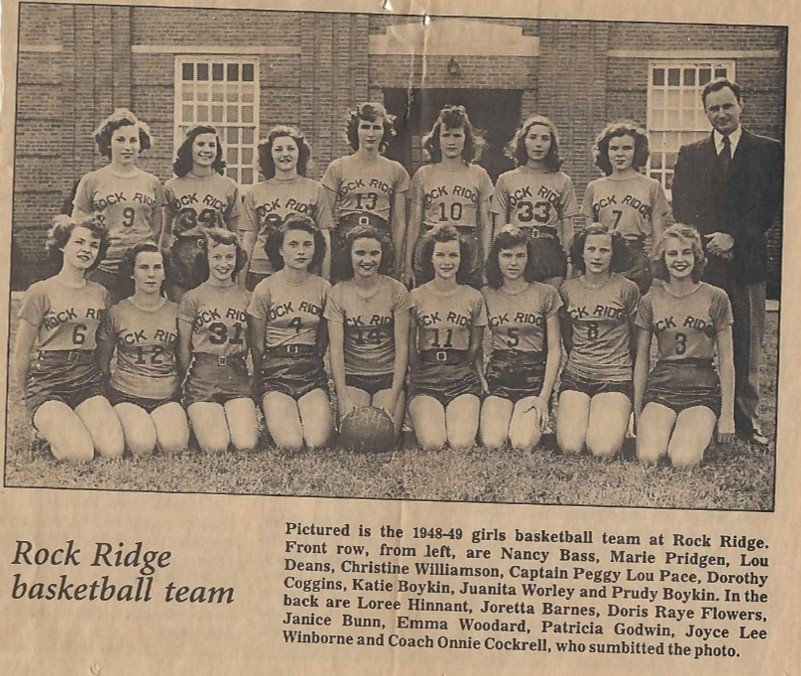
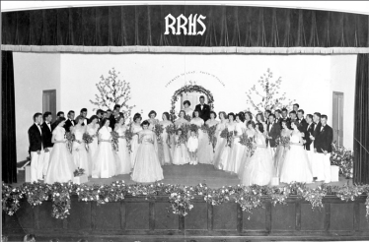
Rock Ridge (1923-1978): High School
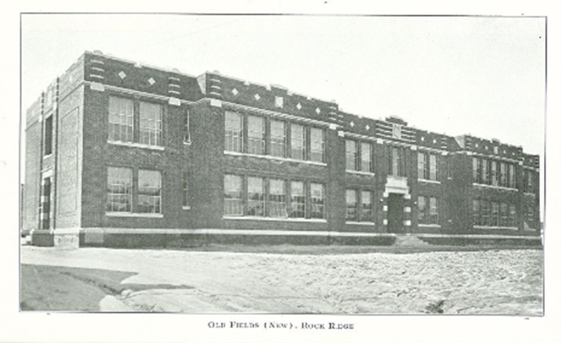
Rock Ridge’s 1923 school was built on nine acres with sixteen rooms and served grades 1 through 11. It enrolled 424 students in 1923–1924 and was described as one of the most modern rural schools in the state at the time of its construction. It served as the high school for students from Bullocks, Buckhorne, Lamms, and Sims, all of which functioned as feeder schools. The building burned in 1938, and a replacement school was completed in 1941. Rock Ridge later became integrated in 1970. The last class graduated in 1978.
Fun fact: Ava Gardener Graduated from Rock Ridge High School in 1939. See more information here.
Rock Ridge School 1951 Yearbook here.
Black Schools after Rosenwald Funding
Sims School, Fisk University Rosenwald Archive
Sims “Colored” School (1929-1951): a two-room Rosenwald building in 1928–1929
Construction and furnishing moved slowly, and the school reportedly struggled with shortages of desks, equipment, and even problems with its well. It closed in 1951.
Sale of Sims “Colored” School
In November 1951, Sims “Colored” School was offered for sale as part of the disposal of former Black school properties. Many such buildings in the county were bought by White farmers and quickly demolished or repurposed, but Sims was one of the few purchased by a Black owner, Grover L. Jones.
2015 NCDNCR Research report: tools for assessing the significance and integrity of North Carolina's Rosenwald schools and comprehensive investigation of Rosenwald schools in Edgecombe, Halifax, Johnston, Nash, Wayne, and Wilson counties, page 223-227
2015 NCDNCR Research report: tools for assessing the significance and integrity of North Carolina's Rosenwald schools and comprehensive investigation of Rosenwald schools in Edgecombe, Halifax, Johnston, Nash, Wayne, and Wilson counties, page 223-227
“Wilson County Schools Institute Large Expansion Program This Year; Two New Colored Schools Are Among Listed Improvements,” Wilson Daily Times, 11 August 1950.
Integration
Although Brown v. Board of Education declared school segregation unconstitutional in 1954, full integration in Old Fields Township schools did not occur until about 1970–1971. “Freedom of Choice” policies in the mid-1960s left the system largely segregated in practice, and stronger federal pressure by withholding funds in 1969 appears to have pushed Wilson County toward final desegregation. Integration was highly controversial and many Black residents faced hostility (See below Sallie Coleman Bynum remembers. Wilson Daily Times, 24 February 1994.) . Sims School and Rock Ridge school was integrated for 8 years before both closed in 1978.
Community and Civic Life
Wilson Daily Times Newspaper Archives May 4, 1996 Page 3
Neighborhoods, churches, civic clubs, and gathering places all played a part in fostering the community of Sims. Neighborhoods did not look like the subdivisions we have today, according to a longtime resident. For example, Sugar Hill was a predominantly African-American neighborhood on the Western outskirts of Town that was settled in 1900s, but many of the original houses in Sugar Hill have been torn down.
Residents still recall good memories of the community they grew up in:
“My husband would talk about catching the train to Wilson with his mother to buy school clothes. He told how he and his friends played in the culvert under the road using candles for light. He told how his father built a Ferris wheel and merry go round that all the children would play on. After supper, people would gather on someone’s porch sit, talk, and laugh until dark. The ladies would bake a pie, cake, biscuits, garden vegetables and fruits to share with us. Sims Methodist Church has always been special to me. Homecoming, Halloween, carnival, weddings, Easter service and egg hunts, Christmas plays, Sunday school classes- friends and family. Miss Annes store was a special place. Boykins Hardware was a gathering place for men. ”
“The Town was full of loving and caring people. There was 3-4 houses on each block. My favorite memories were playing under the streetlights, hiding, riding bikes and roller skates around our block. The cotton gin holds special memories, watching to see how they held the bales of cotton together.”
“Growing up, I spent a lot of time with community members. They feel just as much as family as my own blood relatives. The phrase “it takes a village” was true. The elders raised us. The connection is still there running into them in town. ”
Clubs
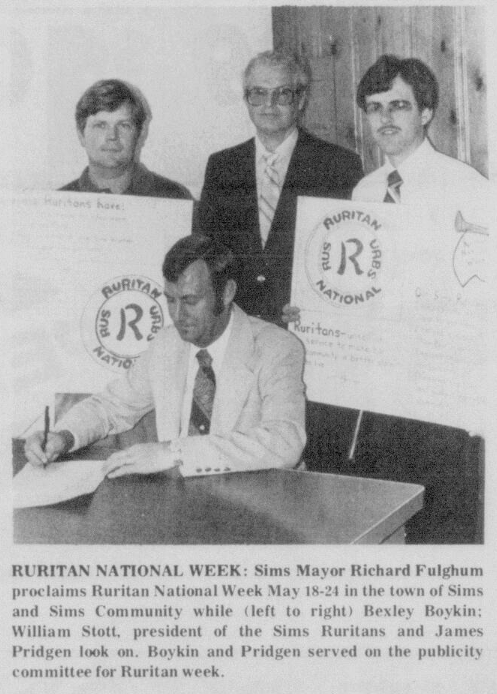
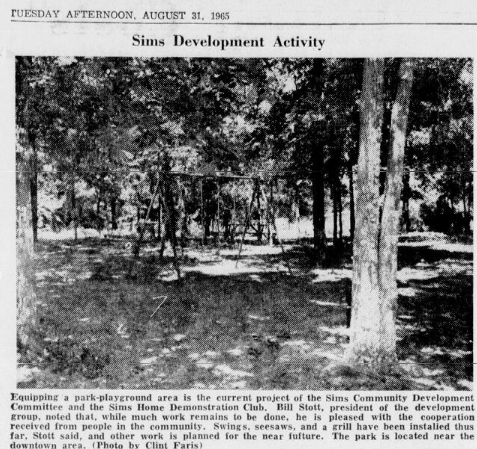
Sims Ruritan Club/Sims Rural Community Club: Formed Sims Volunteer Fire Department, held raffles, suppers, Town Clean-up, donations, Senior Citizen Day, town beautification, and more.
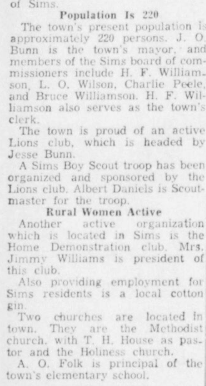
Lion’s Club: Sponsored a Sims Boy Scout Troop
Women’s Home Demonstration Club
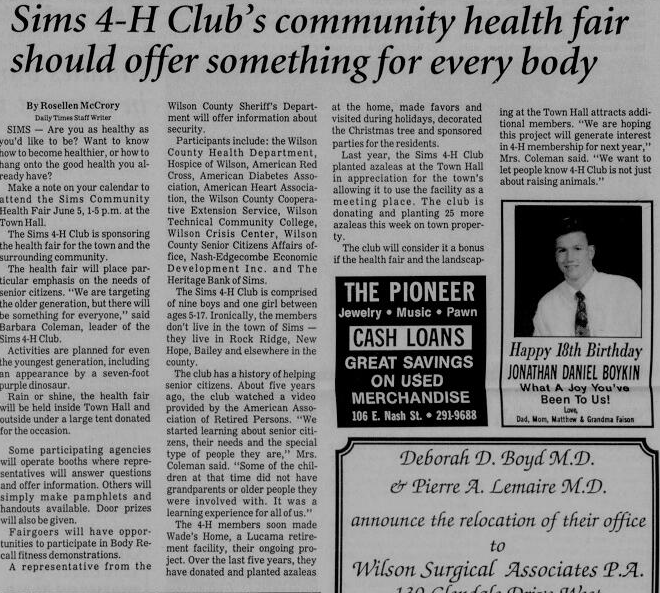
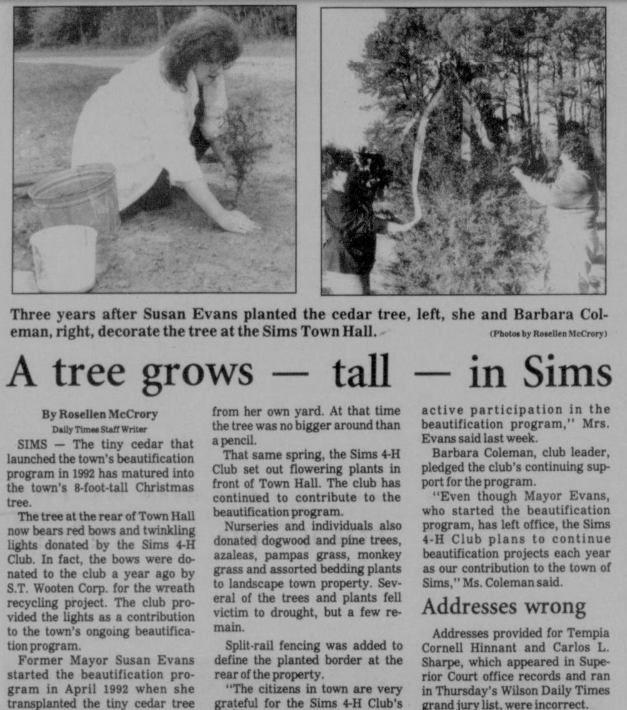
Sims 4-H Club: Hosted a Sims Community Health Fair June 5, 1993, donated and planted azaleas at Town Hall, sponsored parties for Lucama Retirement Home and more.
Work and Enterprise
Timber and farming anchored the early economy. The W. W. Simms mills provided jobs and freight for the railroad. Additionally, Neverson Quarry (c. 1900) was a major local employer, though it had many changes and controversies throughout the years (see end for more information). The Quarry was originally part of the Town of Neverson, which doesn’t exist anymore.
2014 Heidelberg Rock Quarry
According to local tradition, there were two cotton gins in Sims: First or original cotton gin was across the street from modern Town Hall, in the field behind Mr. S Tobacco and Grill. The other cotton gin was located where the current Sims Community Park stands.
In the 1990s, employment opportunities were growing: S.T. Wooten Asphalt Plant (opened in early 1970s); Two new businesses located near sims in 1990: N.C. Chip Co. and Capital Ready Mix Inc.
Businesses
Businesses evolved with the town: general stores, filling stations, beauty and barber shops, cleaning services, a coal yard, a soda fountain, and medical offices, and more!
Burnette General Store (c. 1910) was owned by James Marion Burnett, who also established a cotton gin, sawmill, and lumber business. In 1930, A major fire destroyed the supply company on Highway 91 (Hwy. 264). In 1948, this became J. T. Boykin’s Store (general merchant) with cotton and fertilizer. In the 1990s, the store sold farm supplies, seed, and paint.
Nichols Drug Store and soda fountain located on Main Street was a popular gathering place for residents in 1924. Dr. Thomas Gavin Bradshaw used an office in the back of the store and served patients in the area. The company was sold in 1944 to C.L Smith.
Bexley Boykin standing at J.T. Boykin Store (Hardware, Paint, Fertilzer, Seed), Helen Boykin
Small Town Video (Movies, VCR Rentals, and Sales), Helen Boykin
Wilson Daily Times, Wilson, NC June 17, 1948, 8
This 1948 newspaper shows a variety of businesses including the Grand Opening of Sims Drug Store located on the corner of Raleigh Highway and Main Street on June 18, 1948 from 7:30pm-10pm. Children would receive free ice cream! The structure was built in 1930 by Davis and Mercer, general building contractors. They advertised quality drugs, fountain drinks, drug sundries, and fresh sandwiches. Decades later, this became a pool and video room, Small Town Video. The building is not occupied today.
Lamm’s Shell Service Station (currently Sims Tire and Auto) on Hwy 264 is one of the oldest businesses in Sims. Billy Lamm (William Selby Lamm) started in 1956, when he was 21 years old. His father built the business in 1954 after his original county store on old Raleigh road burned down.
Wilson Daily Times Newspaper Archives February 7, 1978 Page 1
1971 Fire at Sam’s Convenience Store (Then Hamm’s convenience, now Mr. S Tobacco and Grill)
Other stores in Sims included a blacksmith shop, various general stores, service stations, an ABC store, and even a karate school.
Quotes from Interviews:
“I hope this town remains a loving, caring, community where the residents respect and care for each other in good times and bad times. No matter how long you have lived here, you are part of us, the community.”
“The growth of Sims is the biggest change, land being sold, old town has remained the same. I miss the closeness of the residents we used to have, the camaraderie we had. ”
“Sims is home to me. I grew up around it. It has grown up around me. ”
Newspaper Clippings
Wilson Daily Times Newspaper Archives July 2, 1976 Page 32
Wilson Daily Times Newspaper Archives June 6, 1998 Page 1
Jacksonville Daily News Newspaper Archives February 26, 2005 Page 2
Wilson Daily Times Newspaper Archives May 31, 1990 Page 3
Wilson Times Newspaper Archives August 28, 2017 Page 4
Wilson Daily Times Newspaper Archives July 13, 1977 Page 15
Wilson Daily Times Newspaper Archives April 9, 1986 Page 3
Wilson Daily Times Newspaper Archives January 5, 1991 Page 3
Wilson Daily Times Newspaper Archives May 8, 2002 Page 3
1985 Wilson County 130th Celebration in Sims “Sims Day” (there’s a HHS!) May 23, 1985
The Wilson Daily Times Saturday August 25, 1990, P. 3A
Wilson Daily Times Newspaper Archives December 22, 1990 Page 3
“Sims Youngest Town on County; was given Charter in 1923.” Wilson Daily Times Newspaper Archives May 6, 1955 Page 49
Wilson Daily Times Newspaper Archives August 20, 1943 Page 26
For more information about Labor History near Sims, visit the following:
Thank you to residents, Town staff, Wilson County Historical Association, Lisa Henderson, Wilson County Library, and everyone involved for building this Sims Town History project!
sources
“An Act to Incorporate the Town of Simms, Wilson County, North Carolina” NC General Statute (1913, c. 293-294, s.1-7), 5 March 1913.
“An Act to Incorporate the Town of Sims, Wilson County, North Carolina” NC General Statute (1923, c. 58, s. 1-5), 17 February 1923.
Bailey, James A. & Bailey, Margaret B. (2020). “The Town of Neverson in Old Fields Township.” Wilsons Heritage, Newsletter of the Wilson County Historical Association, Volume 9, Number 3. https://faculty.mnsu.edu/jamesbailey/wp-content/uploads/sites/60/2024/02/Neverson-WCHA-Newsletter-Winter-2020.pdf
Bailey, James A. & Bailey, Margaret B. (2022). “FROM SIMMS SIDING TO SIMS: A TRAIN STOP IN NORTHWESTERN OLD FIELDS TOWNSHIP.” Wilsons Heritage, Newsletter of the Wilson County Historical Association, Volume 11, Number 2. WCHA-FAll-10-28-2022-Sims.pdf
Brown, M. A. (2015). Research report: Tools for assessing the significance and integrity of North Carolina's Rosenwald schools and comprehensive investigation of Rosenwald schools in Edgecombe, Halifax, Johnston, Nash, Wayne, and Wilson counties (353 pp.). North Carolina Department of Transportation, Project Development and Environmental Analysis Branch; North Carolina Department of Natural and Cultural Resources. https://files.nc.gov/ncdcr/historic-preservation-office/survey-and-national-register/surveyreports/RosenwaldSchoolsEDHXJTNSWIWL-2007.pdf
Bullock-Dew House — Sims, North Carolina • NRHP #86000759. US Historic Places. National Register Data. https://www.heritageindex.org/historic-places/l/57138/bullock-dew-house-sims-north-carolina-86000759
Celebration held in old fields. (1985, May 23).
Claggett, S. R. (1995). Native American settlement of North Carolina. Home. https://www.ncpedia.org/history/early/native-settlement
Claggett, Stephen R. “Native American Settlement of North Carolina.” NCpedia. State Library of NC. July 2023. https://www.ncpedia.org/history/early/native-settlement
Commission ok’s bank for sims. (1972, May 25). Wilson Daily Times, p. 2.
Coon, Charles L. (Charles Lee), 1868–1927. Public schools of Wilson County, North Carolina. 1924. LA341.W5 C6 1924. East Carolina University Digital Collections. https://digital.lib.ecu.edu/16945
Creech, S. (2000, June 6). Sims providing office for sheriff’s deputies. Wilson Daily Times, p. 1.
D & a appliance. (1992, March 12). Wilson Daily Times, p. 82.
DocSouth & UNC University Library. (2010, March 19). Commemorative Landscapes of North Carolina. Commemorative Landscapes of North Carolina | Nooherooka Monument, Snow Hill. https://docsouth.unc.edu/commland/monument/369/
Dolly Stallings. (1920s). Photograph, Main Street, Sims. From Archives of William Bexley Boykin.
Dun & Bradstreet, Inc. (n.d.). Business directory. Sims, NC - Business Information. https://www.dandb.com/businessdirectory/jtboykinstore-sims-nc-14490600.html
Farming centers in area of sims. (1954, August 13). Wilson Daily Times, p. 34.
Grand opening. (1948, June 17). The Wilson Daily Times, p. 8.
Henderson, L. Y. (2020, July 28). An abundance of good grazing. Black Wide-Awake. https://afamwilsonnc.com/2020/07/27/an-abundance-of-good-grazing/
Lamms station the oldest business in sims. (2018, July 12). Wilson Daily Times.
Leopard, J. (2024, August 21). CLNA 1501 South Train No.114, Sims, North Carolina. Flickr. https://www.flickr.com/photos/john_leopard/53988175050/
McCrory, R. (1990, August 25). Over 50-year period, even small towns change a lot. The Wilson Daily Times, p. 3A.
McCrory, R. (1990b, December). Town residents take pride in first-ever decorations. Wilson Daily Times, p. 69.
McCrory, R. (1991, April 6). Sims regains police department. The Wilson Daily Times, p. 3A.
McCrory, R. (1993, May 22). Sims 4-h club’s community health fair should offer something for every body, p. 3.
McCrory, R. (1994, February 24). Sallie coleman bynum remembers. Wilson Daily Times.
Millar, G. (2024, May 17). Who are the Tuscarora Indians? America Explained. https://www.americaexplained.org/who-are-the-tuscarora-indians.htm
National Register of Historic Places Inventory- Nomination Form for Bullock Dew House. State of North Carolina Division of Archives and History. https://files.nc.gov/ncdcr/nr/WL0695.pdf
Ohno, Kate. (1981). Wilson County’s architectural heritage. North Carolina Department of Cultural Resources, Division of Archives and History, US Department of the Interior.
Old Fields Township Pictures and Articles Presented to the Town of Sims by William A. Stott (1987).
Page, C. E. (1943, August 20). Town of sims owes no debts and is busy rural community. Wilson Daily Times, p. 26.
Parramore, Thomas C., Jr., Stevenson, Harry L. Thompson, and Louis P. Towles. “Tuscarora People.” NCpedia. Library of NC. September 2025. https://www.ncpedia.org/american-indians/tuscarora#citation
Rock Ridge School (Wilson N.C.). (1951). Pebble [1951]. DigitalNC. https://lib.digitalnc.org/record/36758?v=uv#?xywh=-439%2C0%2C3596%2C3767&cv=4
Rock Ridge School 1951 Yearbook: https://lib.digitalnc.org/record/36758?v=uv#?xywh=-439%2C0%2C3596%2C3767&cv=4
Ruritan national week. (1980, May 19). Wilson Daily Times, p. 15.
Sims Community Rural Fire Department. Sims Community Rural Fire Department | Sims, NC | Cause IQ. (n.d.). https://www.causeiq.com/organizations/sims-community-rural-fire-department%2C581385938/
Sims gets its first fire station. (1983, February 28). Wilson Daily Times, p. 69.
Starling, C. (1978, February 7). ABC store at sims will be relocated. Wilson Daily Times, p. 1.
Tuscarora Band of Six Nations Indians. (n.d.). Skarù:RĘʔ Tuscarora History: We Are Still Here. https://tuscarorabandindians-govtribe.co/history
Whitley, G. (1971, February 19). Fire breaks out at convenience store. Wilson Daily Times.
Wilson County Local History and Genealogy Library. Flickr. https://www.flickr.com/photos/wilsonlocalhistory/
Wilson County Public Library. (2026, May 14). Wilson County Local History and Genealogy Library. Flickr. https://www.flickr.com/people/wilsonlocalhistory/